
Wood County Address History Sources
No single roll names every person who occupied a Wood County property. Start with the source nearest the period, then test the result against another record. Property cards and deeds identify owners. Parkersburg directories may identify occupants. Census schedules add households, while maps show whether a structure or street number existed at the time.
| Source | Years It Covers | Where Held | What It Shows |
|---|---|---|---|
| Deed books and index | 1799 to present described by clerk | Wood County Clerk and portal | Parties, dates, instruments, book/page |
| Parkersburg directories | 1877 to 2016 holdings, with gaps | WV Archives, WVU, library, 1907 scan | Names, addresses, occupations, household marks |
| Federal census | Public schedules through 1950 | National Archives and library tools | Households and enumeration place |
| Sanborn maps | 1889 to 1926 Parkersburg sets | WVU and Library of Congress | Street labels, footprints, building use |
| Ward and city records | 1897 to 1910 examples, council film | WV Archives and Parkwood Library | Assessment, voter, and civic context |
For a recent address, begin with the current parcel card. For a twentieth-century household, use the nearest directory year and census. An older lot may require a deed description, plat, or Sanborn sheet before a modern street number helps. Gaps in printed runs mean a missing name is a reason to change repositories, not proof of absence.
Fix the Wood County Address
Write down the address exactly as each source labels it. In CAMA, the parcel address is the situs, or physical property location. The owner mailing address may differ. A deed may identify a lot, subdivision, survey, or boundary and omit the house number. E911 and USPS labels serve other purposes. Treating them as one field can attach the wrong family to land.
The Wood County CAMA search accepts parcel address, owner, account, district, map/parcel, legal description, and deed book/page. Save the parcel ID, situs, legal description, owner, mailing address, and deed reference. If the text search fails, orient the location in the county address map, then confirm it in CAMA.
That small packet keeps a search reproducible when spelling, numbering, or city labels change. It also separates the parcel from a person. A present owner is evidence about title, not automatic proof of who occupies the building.
Trace Wood County Previous Owners
The deed chain forms the backbone of an address history. The Wood County document index supports date, party, associated name, category, subindex, document type, and book/page work. A grantee receives property; a grantor transfers it. Search both roles because spelling, co-owners, estates, trusts, and corrective deeds can break a simple name trail.
- Pull the current owner, legal description, parcel ID, and deed book/page from CAMA.
- Find the purchase under the current owner as grantee. Save the date, parties, instrument, and book/page.
- Read the deed for the seller and any prior-deed citation. Search that seller as a grantee earlier.
- Repeat backward, checking correction, trustee, tax, partition, probate, plat, easement, and right-of-way records when relevant.
- Move to the clerk record room, deed books, or archive microfilm when the online trail is incomplete.
- Grantor / grantee
- The grantor transfers an interest; the grantee receives it.
- Chain of title
- The linked sequence of recorded transfers for the same land.
- Legal description
- The lot, tract, survey, or boundary wording that survives a street-address change.
Wood County Records Beyond Online
The portal is an index-and-image workflow, not the whole record room. The county describes deeds and liens from 1799 to the present. The State Archives lists deed books from 1802 to 1901 and indexes from 1798 to 1969. Those ranges overlap but describe different holdings. Preserve each citation and ask which book or film contains the earlier instrument.
The Wood County Clerk keeps the public record room on the first floor at 1 Court Square, Parkersburg. Hours are weekdays from 8:30 a.m. to 4:30 p.m., and the record-room phone is 304-424-1870. Mail and in-person copy routes remain available. Staff do not perform title searches, so researchers follow names and book/page references themselves.
Older land books may be off-site. The State Archives coverage note helps identify surviving books. A portal miss should therefore lead to the clerk, archives, or library instead of ending the chain.
Decode Parkersburg Previous Residents
The 1907 W.M. Barnes directory uses address forms that modern search boxes may reject. Examples include a corner at Dickel Avenue and Pine, 506 1/2 Market, and Tavennerville. The letter h marks a home after a work address. Telephone numbers appear in parentheses. “(& Mrs)” is a household notation, not proof of a legal relationship.
Keep the original line and make a separate modern search form. Dropping a fraction, corner mark, initial, or spaced surname can erase the match. The digitized 1907 directory allows direct page inspection.
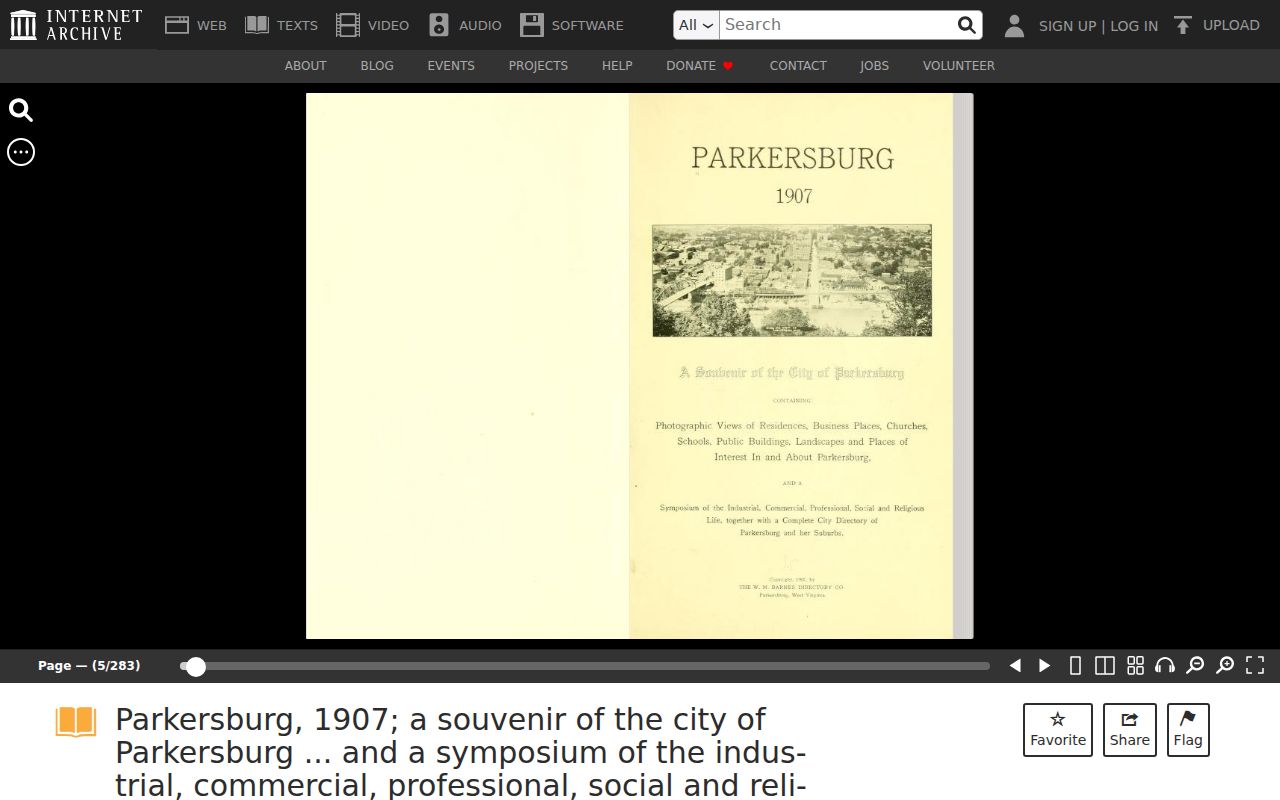
The scan shows why a page image needs its year and page citation. It should not be reduced to a modern address alone. The full holdings are treated on the Wood County city directory page.
Map Wood County Past Residents
Directories name people, but Sanborn maps test whether the building and number fit the period. The WVU Regional History Center has digitized Parkersburg sets from 1889, 1893, 1898, 1904, 1909, 1916, and 1926. The Library of Congress presents the 1916 edition in 40 sheets, including North Parkersburg.
Match the street, cross street, footprint, and use on a sheet to the deed lot and printed directory address. A map describes a structure and place, not an occupant. It helps when an address disappears, changes form, or belongs to a rear lot. No official Parkersburg renumbering crosswalk was located, so do not invent a year for a presumed number change.
Note: A Sanborn footprint supports the location and era of a structure, but it cannot identify who lived inside it.
Wood County's Split Record Trail
Wood County has built five courthouses since its formation in 1798. That long history helps explain why records for previous residents are divided among the modern county portal, courthouse books, archive microfilm, and local collections. No documented courthouse disaster destroying a specific run was found, so a missing online year must not be described as a lost record.
The archival ranges are unusually deep. State holdings list marriage records from 1801, wills around 1800, births and deaths from 1853, deed indexes from 1798, and deed books from 1802. A statewide preservation project in 2013–14 digitized 1,797 books and 189 microfilm rolls in participating counties, including Wood. That milestone does not mean every scanned page is searchable on the county portal.
When one source stops, carry the same surname, address form, legal description, and period into the next repository. County books, State Archives films, Parkwood Library holdings, WVU collections, and historical-society files overlap without sharing identical coverage. Record where each negative search occurred.
Place Names Hide Previous Residents
Older records may use a community name instead of a modern postal label. Parkersburg, Vienna, Williamstown, Mineral Wells, Belleville, Davisville, Rockport, Walker, Washington, Waverly, and Tavennerville appear across Wood County sources. Search each place form found in the record rather than forcing every result under Parkersburg.
Volcano is a striking example. The oil-boom town formed around 1870 and once had homes, stores, churches, schools, hotels, an opera house, and a post office. A fire destroyed much of it in 1879, and the railroad was later dismantled. Someone tied to Volcano may therefore appear in a place, land, newspaper, or family record that has no current street equivalent.
The Phelps-Tavenner Research Center offers another place-based path. The Wood County Historical and Preservation Society holds local books, maps, photographs, scrapbooks, cemetery material, yearbooks, and family files. Supply both the current and historical address strings, approximate year, surnames, and any deed book/page when asking for help.
Confirm Wood County Past Households
Ownership and occupancy are separate questions. A directory can place a named person at a Parkersburg address, while a census schedule shows a household near a decennial date. Work from the closest directory year toward the census, using the ward, place, names, ages, and relationships only as recorded.
- Record the directory year, page, exact name, initials, address spelling, occupation, spouse mark, and telephone notation.
- Check prior and next available directory years to bracket when the named household appears or leaves.
- Use the nearest public census, then match the place, household names, ages, and address context.
- Compare the result with deed dates, the 1910 ward collection, a Sanborn sheet, or a newspaper notice.
The Parkersburg and Wood County Public Library genealogy service accepts focused obituary and census requests. Its stated minimum is $2, copies cost $0.10 per page, and up to five requests are allowed. An obituary request needs at least a month and year; a census request needs the state, township or district, and year. Newspapers, cemetery files, probate, and historical-society family files can then explain where past residents went or when they died.
Lawful use. Research previous residents for house history, family history, and lawful personal curiosity. Never use an address trail to harass, intimidate, or track a living person.